Search Press, June 2023, 208 pg. ISBN 9781800920057
Award-winning jewelry designer Seijen ten Hoorn’s book is a visual feast that will likely appeal to all creatives. The author has a master’s degree in jewelry and metalwork, and she generously shares her training. The book’s helpful index directs readers to a massive number of topics—sketching, model making, mold making, saw piercing, surface finishing, press forming, and more—for all kinds of jewelry. Readers are treated to a taste of each topic. There are also lists of resources that creatives can explore in greater depth. In addition to rings, pendants, brooches, cuffs, bracelets, and necklaces, there are explanations and descriptions of many contemporary earring styles (e.g., ear climbers and huggies) that a youthful crowd will likely appreciate. Throughout the book, there are valuable tips designed to generate ideas. The author encourages artists to arrange, tinker, and play with materials by using mood boards, sketchbooks, and inexpensive models. Design for Jewellery Makers is a comprehensive overview of jewelry design that also offers creative exercises for aspiring artists.
Walter Isaacson, who frequently writes about male scientists and business leaders, devotes an entire biography to female scientist and Nobel prize winner, Jennifer Doudna. Though Isaacson has often written about great men, e.g., Leonardo Da Vinci, Benjamin Franklin, Albert Einstein, and Steve Jobs, he dramatically changes course in 2021.
With the publication of Code Breaker, Isaacson focuses, for the first time, on a female innovator and businesswoman, Jennifer Doudna, the co-winner of the Nobel Prize for Chemistry in 2020.
Isaacson's portrait of Doudna, who co-created CRISPR is balanced and nuanced. Isaacson describes the career difficulties she faced, her competitive drive, and judiciously considers the claims of her detractors.
According to Isaacson, there have been three revolutionary discoveries--the discovery of the atom, the bit, and the gene--that were watershed discoveries.
The discovery of the atom in the beginning of the twentieth century led to many inventions, including the atomic bomb. The digital age ensued from the discovery that a "bit" that could encode information. Lastly, the discovery of the gene led to the knowledge of the genetic code.
Isaacson captures details about her early life that prefigures her future success. He explains that Doudna became inspired to study science not only because she explored Hawaii's wildlife but also because of a seminal work, The Double Helix by Francis Crick. Doudna's father left the book on his daughter's bed when she was a pre-teen because he knew it would fascinate her.
Ignoring a school counselor's misgivings, Doudna majored in chemistry at Pomona College. From there, Isaacson takes readers on Doudna's intellectual journey--her early successes and triumphs--while also revealing her competitive spirit.
Doudna's first husband did not share her drive and that ultimately led to their breakup. Her second husband shared her enthusiasm for RNA--a molecule that would become her primary focus. While other scientists were content to read the genetic code, Doudna wanted to edit it using RNA.
To be fair, Isaacson has long recognized the accomplishments of women. His book, The Innovators, for instance, warmly commends Ava Lovelace and Grace Hopper. Code Breaker is, however, the first time Isaacson focuses exclusively on a female innovator.
Alison Hawthorne Deming (Science and Other Poems)
has compiled a collection of 90 poems that rings alarm bells, reminding
readers that the world is losing animals and their gifts at a
horrifying rate. The poems are written by a wide range of
contributors—some well-known, some relatively new. Some writers based their work on oral traditions.
With topics that range from praise to the future of
animals to companionship, the poets consider the grandeur of animal
life, the grief of impending loss, and hope for future generations.
Some
of the animals that are in peril are seen as protectors; in “Tecolote,”
Jose Hernandez Diaz expresses his thanks for owls, the “protector(s) of
the moon and sky.” While, arguing against the idea that snakes are
sinister and sly, Denise Levertov writes, “Come into animal presence. /
No man is so guileless as / the serpent.”
In nature, there are no hard
lines, and Nickole Brown’s “A Prayer To Talk to Animals” sums this up
beautifully, “Am I not an animal / too?”
A thought-provoking collection of poetic gems
that will inspire and remind readers of the importance of connecting
with the natural world.
Jane's Jam is a blueprint to navigate personal and professional setbacks,
something we all need during these turbulent times. The author’s first
book, Butter Side Up, explored hardships Enright faced during her
worst year, but her latest focuses on the framework she developed to
bounce back from her struggles.
She calls her approach, the OMG
playbook, which encourages “outside in” thinking and taking steps to
practice mindfulness and gratitude. She believes difficulties, when
viewed through the right lens, can become opportunities.
Enright explains
this process in 12 chapters and a summary. The “Go Routes” are
activities she provides to make this easy to incorporate into daily
living. She also includes 52 inspirational quotes from her previous book
and additional resources, and she references motivational writers and
studies that back her claims.
Numerous examples of sports figures, such as
Terry Fox and others who have transformed their lives, are an inspiring
read. Some may even want to become head coach of their own lives using
Enright’s strategy.
Ceramic artist and designer Reinhardt offers the third book (after Sunshine Cobb’sThe Beginner’s Guide to Hand Building) in the “Essential Ceramic Skills” series. Reinhardt’s title is a great introduction to surface decoration; it focuses on the most appealing aspect of pottery making—the patterns and glazes. The book gives useful tips for safety and how to position pieces in the kiln. She also warns crafters to test underglazes. The book encourages experimentation and describes how it led to the author’s signature gold luster and the decision to make functional objects as well as art pieces. The author provides instructions for creating tableware, coasters, ceramic beads, and vases. For the tableware and spoons, there are explanations about how to use nontoxic, food-safe glazes. In the “Gallery” sections, the book spotlights the creative work of other ceramicists. There’s also an extensive list of supplies, tools, and publications, plus recommendations for books, workshops, residencies, and podcasts.
Functional and beautiful, this book will likely inspire readers want to perfect their pottery techniques. An excellent and useful purchase for libraries with vibrant art communities.
Research scholar emerita, B. Rosemary Grant recounts her amazing accomplishments with humility and humor in this delightful memoir. Growing up in the Lakes District in England, Grant was surrounded by wildlife. Since her village, Arnside, was near a tidal bore, she quickly learned to read the tides. She learned to love science because, as she puts it, she was surrounded by science. Like many women pursuing a career in the sciences, however, she faced numerous obstacles; hence, the “one step sideways” in the title. Even her forward-thinking father believed that a university career and a family were mutually exclusive. Fortunately, Rosemary met Peter Grant while teaching embryology in Canada. The two would fall in love, go on to marry, and forge a rare partnership that would greatly profit the field of evolutionary biology. Though she had to forestall her Ph.D. project while Peter actively pursued his, Rosemary later earned her Ph.D. from University of Uppsala. Combining research with family life, Rosemary produced a landmark study of rapid evolution in the Galapagos that germinated from forty years of research.
Don’t miss this incredible story of an evolutionary scientist who combined her love for science with love and devotion to her family, the environment, and many social causes.
In ten stories, Vara describes the gamut of human
predicaments and their corresponding emotional states: grief,
isolation, obsession, shame, courage, and rage.
Each story exists in isolation,
but numerous stories mirror each other. Grief in
response to losing a sister is apparent in “Hormone Hypothesis” and
in “Eighteen Girls.” The unnamed character in “Hormone Hypothesis,” who
is unconsciously looking for a sister figure, finds Fernanda. Though this
stay-at-home mother is the narrator’s opposite, the two
bond and find strength in their shared grief.
A complementary story, “Eighteen
Girls,” features two sisters, one of whom is slowly dying of cancer.
The “eighteen girls” of the title are the same girl—the
healthy girl reacting to her sister’s forceful personality.
“The Irates” and “I, Buffalo”
deal self-hatred and shame. In “The Irates” a
teen finds the world irretrievably altered after
her much-loved brother dies. She works a job she detests—telemarketing—and
becomes a person she hates—an “irate.” Sheila, the main
character of “I, Buffalo” has lost her high-stakes
job after an embarrassing incident. Vara brilliantly
describes emotional states, especially isolation.
In “This is Salvaged,” a man
has the lonely experience of trying to build a replica of Noah’s
ark and in “Sibyls” a woman with a movie star’s name dies unnoticed.
This is Salvaged is a compelling short
story collection that visits aspects of the human condition with humor and
nuance.
Artists and doodlers will love this step-by-step method of
drawing sixty different animals using simple shapes like rectangles, triangles
and semi-circles. Kim makes the process easy with clear directions for making
the cute critters. Graphic Designer and illustrator, Heegyum Kim, masterfully simplifies heads, torsos, legs of farm
animals, woodland creatures, and animals from many other biomes. All of them
have cartoon-like rounded features and appealing faces.QR codes link to videos of Kim demonstrating
her craft. Each animal is given a range of expressions and poses. Fun and easy to follow, this technique book will be
enjoyed by all age groups.
In her youth, Clare spent all her time with Patrick Carraday, the son of one of richest men in Galveston. Patrick who lives in the large historical home adjacent to her own is wild and reckless. Drawn to each other, they become confidantes and co-conspirators. After a shocking and horrifying incident that alarms both of their families, the two of them are sent away--to opposite corners of the world.
Clare is sent to Ohio where she marries and establishes herself as a successful photographer. After her daughter's death, though, and with her own marriage crumbling, Clare returns to the island that relentlessly calls out to her. Though Eleanor, her mother, and Faline, the cook, try to dissuade her from seeing him, she persists in searching for Patrick who eludes her.
Clare ostensibly returns to Galveston to create a photographic exhibit. Clare has an even more urgent need, however, to excavate her past. She wants to understand her mother and father's coldness towards her. Most of all, she wants to know what happened after she and Patrick were sent away.
Many stories swirl around the Carraday family, including the one about Stella who had become part of the island's lore. Clare identifies with Stella, who died while trying to escape the hurricane of 1900 with her architect boyfriend, Henry Durand, because Stella is also a rebel.
As Clare sifts through ancient photographs, Clare tries to comprehend Stella's story. She planned on including Stella's story at her own photography exhibit. She is unprepared, however, for what she finds--a photograph of a woman that may be Stella. If it is Stella, then the photo could prove the island's legend wrong. Stella may have survived the storm and she may have been forced to return to the Carraday house.
Clare uncovers many more secrets--a secret relationship between Will Carraday and her own mother. As memories flood in, Clare begins to understand her difficult, complicated relationship with her father and sister. Clare pieces together the real reason she and Patrick were forcibly separated.
This novel captures the Galveston atmosphere perfectly as well as the isolation and the pride of its inhabitants. Inhabitants are proud to point out if they were BOI or born on the island. Black also depicts the island's rich history and its vulnerability.
Clare mirrors the island's qualities. She feels isolated and vulnerable because certain facts have been kept from her. The truth, however, will set Clare free to be the artist that she was always meant to be. Black includes just enough mystery to keep readers hooked.
Is it really possible to make a living while pursuing your art? Mason Currey explores this intriguing question in Making Art and Making a Living. Currey explains how Petrarch, Baudelaire, Van Gogh and other notables funded their art careers. In a breezy style, he places artists into categories. They either inherited wealth, mooched off of others, or worked odd jobs. A select few worked parallel jobs, insurance, law, or medicine, while some worked in cultural institutions, e.g., Museum of Modern Art. During the depression, many artists benefited from the Federal Arts Project. This really isn't a how-to for funding art careers, but it satisfies those who are curious about artistic achievement.
Fanny Strikes Backby Avi Luxenburg is a fast-based, exciting read for YA readers who like adventure. Obsessed with karate, Fanny Berk is a complex character that readers will cheer for. Dressed in drab colors and hiding behind her hair, Fanny is a teen who wants to go unnoticed. As fate would have it, though, she does something that surprises even herself. She finds herself in theFlowand acts on her impulses—sending a set of actions in motion that will change her life.
Tired of school bullies, she uses her karate skills to take down two of the school’s worst bullies. Her actions cause some to call her a hero and a ninja, but she is mostly embarrassed by what she has done. Even worse, her actions could cost her the only passion she has—her beloved karate class. Young adults will relate to this all or nothing scenario, “Karate was everything, and I might lose it all.”
Set in British Columbia, Luxenburg includes a wide cast of characters from different backgrounds. Fanny’s family is Jewish who have experienced prejudice and persecution from a group called The Movement. Despite having to move and lose her only friend, Fanny overcomes her isolation with grit and moral courage.
Fanny's character arc is impressively steep. She goes from talking to herself, disliking dogs, to becoming a “dog” person with actual friends, a group of gifted kids who call themselves the Motley Crew. Using their varied talents, the crew investigates crimes happening inconspicuously in their own neighborhood.
Luxenburg, who was an educator, gets the school setting exactly right. He compares the halls to teeming schools of fish and the bullies as sharks. Even more dangerous than the bullies, an underground protection racket, comprised of immoral adults, is recruiting students. Unless Fanny and her crew can stop them, there are ruffians who pose more danger than the school's worst bullies.
Young adults will love Fanny and her crew who show initiative, self-sufficiency, and creative problem solving in the trickiest of situations.
Ray Bradbury issued two versions of this short story. The first was published in Collier's and the second version was published in The Martian Chronicles.
In the second version he includes a new metaphor:
"The house was an altar with ten thousand attendants, big, small, servicing, attending, in choirs. But the gods had gone away, and the ritual of the religion continued senselessly, uselessly."
This change is an important one. The house is now characterized as an altar while the technology are the choirs or servants in attendance. The house or "altar" is a place where rituals continue long after they are necessary.
The stove continues to make breakfast even when there are no people left to eat it. In fact, immediately before the house is ruined, the house's technology goes into a frenzy. The stove makes breakfasts "at a psychopathic rate, ten dozen eggs, six loaves of toast, twenty dozen bacon strips."
Not only does the stove misidentify the time--its well after 10 PM--the stove produces an enormous quantity of food. The stove would not need to cook ten dozen eggs for the four people living in the house--Mr. and Mrs. McClellan and their two children.
The "gods" he spoke of in the altar metaphor are clearly the family who no longer need to eat breakfast. He said "the gods had gone away," a sly reference to the fact that the family are now silhouettes on a charred exterior wall of the house.
Though computers had not been invented in Bradbury's time, he gives the house a CPU--an "attic brain" that fails to correctly direct the pumps to put out the fire.
The "choirs" that so obediently did the work of the humans fail all at once. The lawn mower begins cutting the grass, the front door opens and closes, the umbrella in the lawn opens and closes. Bradbury writes that there were "a thousand things happening" and that there was "maniac confusion" when the smart technology fails.
He calls the end, when the house is in its death throes, a "rain of fire and timber."
The attic or brain has been overthrown causing all of the technology to malfunction. The technology continues to operate haphazardly, a voice continues to announce the day of the week. This ritual, like the poetry ritual, is no longer necessary since, unfortunately, there is no one left on earth.
Mickey, a police officer, narrates the Long Bright River, a compelling story of two sisters on opposite sides of the law. Both Mickey and Kacey come from the same hardscrabble neighborhood in Philadelphia. They were raised by their taciturn grandmother, Gee.
This part of the story is easily recognizable. Since their mother died of an overdose and their father abandoned them, they are raised by a bitter grandmother. She bitterly laments the death of her daughter who overdosed and left her to two children to raise.
Gee raised the girls without much joy or hope. The only bright spot in the girls' lives is their fierce bond and a secret hiding place where their girls share their favorite knick knacks and correspondence
The community Moore describes, Kensington, is a real community carefully researched by the author. Kensington is a working class district known for poverty, homelessness, and drug use.
What is the long, bright river? The reader does not know at first. Moore is writing about the "invisible people", the homeless and vulnerable, that most ignore.
Mickey has become a police officer whose job compels her to interact with this drug using crowd. Meanwhile, her younger sister, Kacey, has become one more of the nameless and invisible.
One of the working girls alerts Mickey that her sister has disappeared. Though she has a young son, Mickey does some investigating. At this point, the novel shifts into high gear and becomes a thriller.
Mickey's choice to investigate her sister puts her in danger especially as there is a serial killer on the loose, one who is specifically targeting the ladies of the evening.
Rumors circulate that the perpetrator may be one of Philadelphia's own PD. This puts Mickey in even more danger. She never knows who may be observing her or who may be hostile to her unendorsed investigation.
The killer could be anyone on the force. She even suspects her ex and her former partner who frequent Kensington at odd times. To top it all, someone has been bothering her landlady and asking questions about her.
Moore deliver a first-rate thriller while also drawing attention to poverty, drug abuse, prostitution and other social problems in the Philadephia community.
Long Bright River has recently been adapted into a miniseries on Peacock starring Amanda Seyfried.
In Wanderers an unknown pathogen wreaks havoc across the United States.
The virus makes a zoonotic jump from bats to humans resulting in a pandemic, civil unrest, and pandemonium.
While all this sounds familiar to what we’ve experienced with Covid-19, Wendig actually began devising the novel in 2016–four years before the Covid 19 outbreak.
In addition to the pathogen, characters also grapple with an AI that becomes sentient and autonomous, Black Swan.
Sadie explains how discomfiting the technology can be:
“Imagine that you create this thing, this quantum computer mind, and you begin to train it, and you realize it has a mind of its own. And then, on day, it tells you something: It has been speaking to itself in the future, and it believes that civilization will one day end.”
Though she believes she controls it, the AI begins to act independently. Predicting the pandemic, Black Swan takes control of a nanotech company and its swarm of nanotech bots. BlackSwan’s actions ensure that a portion of humanity will survive albeit at a great cost.
The lives of a disgraced scientist, an aging rock star, a teen-aged aspiring photographer, and a preacher intersect in this trenchant novel. As they become personally drawn into the crisis, each of them grapples with the politicization of the pandemic and the moral uncertainties of AI.
If you enjoy The Last of Us, you may enjoy this novel.
Chuck Wendig has also written Star Wars: Aftermath (2015), Invasive (2016), and The Book of Accidents (2021).
The Last of the Hunter-Naturalists: Ted and Kermit Roosevelt.
While it seems counterintuitive to us today, many hunters were also conservationists. Theodore Roosevelt and his sons, Ted and Kermit Roosevelt, were some of the last hunter-naturalists.
Hunter-naturalists believed the only way to study, and ultimately conserve a species, was to hunt and shoot specimens.
A rifle gifted to Theodore Roosevelt displayed in the National Museum of American History’s 2020 exhibit, “Elephants and Us”, exemplifies this paradox. The rifle was given to Roosevelt for “his services on behalf of preservation of species.”
Theodore Roosevelt is known for conserving 230 million acres of federal land — turning the lands into preserves, refuges, and national parks. He was also an avid hunter who passed that tradition on to his sons, Ted Jr., Kermit, Archibald, and Quentin.
Roosevelt Sr. was well-known for hunting big game — elk, bear, elephant, cougar, buffalo, yet he was also known for advocating “fair play.” He famously refused to shoot a bear in Mississippi because it was tied to a tree. Roosevelt Sr. considered it unsportsmanlike to shoot a bear that was unable to run or defend itself.
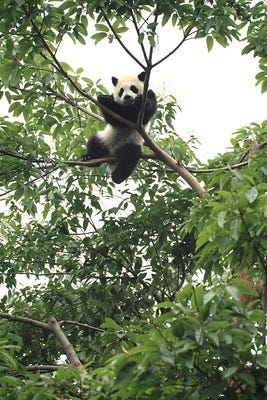
Ted and Kermit Roosevelt, who are eager to prove themselves after several personal and financial scandals, embark on a mission to find China’s mystical black and white bear. In order to study it, they will shoot, skin, and mount the animal in a museum.
Before the invention of tranquilizers, GPS tracking devices, and satellites, capturing and killing an animal was the only practical way to study a species. Naturalists like Charles Darwin and John James Johns routinely killed their animal subjects to study them.
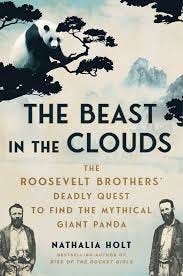
The Beast in the Clouds by Nathalia Holt (2025)
During the 1928 trip to Asia, the Roosevelt brothers and their party collect unusual sheep and deer specimens e.g. Marco Polo sheep, bharal, and serow. In fact, Nathalia Holt writes in her 2025 book on the exploration that the party collected 5,000 bird skins, 2,000 small mammals, and 40 large mammals.
Surprisingly, until 1869, the Westerners had not even heard of a panda. The animal first became known to the West when Armand David, a missionary who was proselytizing in China, sent a Panda skin to Paris. David called the specimen a beautiful black and white bear.
The Chinese, however, considered the panda sacred. Though panda were elusive and rarely seen, early Chinese Emperors believed pandas were supernatural beings that could ward off evil spirits and natural disasters. Killing the panda or “beishung” was unthinkable to the Chinese.
In modern times, the Chinese call the Giant Panda or “daxiongmao” and it has become a cultural symbol. In the past, though, it was associated with many myths. Because the panda was elusive, it was mysterious and associated with mythological beings — Mo, a black-and-white bear that could eat metal or shitieshou, another iron-eating beast.
To help secure a panda, the Roosevelt recruit hunters from the Yolo region. These local hunters, however, were not only inexperienced, they also feared killing a “beishung.” They did not fear the bear’s aggression so much as they feared killing a sacred animal.
The brothers had already undergone too many trials to let that stop them. They had faced the drudgery through the “Valley of death,” close scrapes with bandits, life-threatening illnesses, and the constant danger of being caught up in China’s war between the Kuomintang and the Communists.
The panda specimen should have been the culmination of the expedition; yet, for the Roosevelt brothers, it was anticlimactic. Shortly after killing the bear, the brothers became downcast. As they prepare to ship the panda home to the Field Museum, news of the hunting party’s success creates a panda craze in the United States.
For the Roosevelt brothers, life would never be the same. For them, the great bear hunt and hunting, in general, is over. They would give speaking tours but would feel haunted by the expedition and its unintended consequences. Hunters want to use the brothers’ maps of the panda’s territory to bring home more panda carcasses or live cubs.
Before his death, Kermit works for a zoological society. He successful saves the Galapagos tortoise from extinction and calls for a complete ban on panda exports to the United States.
For more about Ted and Kermit Roosevelt’s life after the expedition, read Nathalia Holt’s The Beast in the Clouds.
A friend posted this to her FB page and I thought it was not only perfect for poetry month but for writing in general.
We are gatherers,
the ones who pick up sticks and stones and old wasp’s nests fallen by the door of the barn, walnuts with holes that look like eyes of owls, bits of shells not whole but lovely in their brokeness, we are the ones who bring home empty eggs of birds and place them on a small glass shelf to keep for what? How long? It matters not. What matters Is the gathering, the pockets filled with remnants of a day evaporated, the traces of certain memory, a lingering smell, a smile that came with the shell.
~ Nina Bagley
Click on Subscribe to posts below or "follow" above this post.
Comprised of six loosely interconnected stories, Dayton’sStronger, Faster and More Beautifulgives young adult readers a horrifying glimpse into the future of genetic research. The stories grow increasingly dark and complex until the last one that ends with a glimpse of redeeming hope.
In the first story, a twin is tricked into accepting a surgery that will make uses of his comatose twin’s healthy organs. He states unequivocally, “I wake up and know that my parents have tricked me, or rather, that they had the nurses drug me.”
In another story, a girl becomes traumatized after her romantic interest, Gabriel learns she has been genetically modified. A modified heart, artificial skin and a “meshline” has been added to her body. Betrayed by Gabriel and ostracized at school, Ludmilla exacts a terrible revenge on her persecutor.
These modifications, though protested by Rev. Tad Tadd’s followers, are more or less medical procedures. In the later stories, the ethical line between beneficial and deleterious procedures are further blurred.
In the third story or “part” called “The Reverend Mr. Tad Tadd’s love Story,” a girl learns that her father, the Reverend Tad Tadd has reversed course. When it was convenient to him, after losing his wife and son, he embraces the genomic technologies he railed against.
The procedures have become monstrous, and they are sometimes done without the individual’s consent. Plus, as Elsie points out its a convenient about-face for her Dad: “You’ve changed your mind now because someone you loved died. But — but — kids in hospitals…they’ve been dying all along.”
The modifications have become even more extreme in Part 4. An experiment to increase a boy’s intelligence has gone horribly wrong. His parents abandon him to a clinic which then transfers him to another clinic in Greece. His intelligence cannot be used for any practical purpose and his body has been exploited for the clinic’s cause.
In Part 5, a dying boy’s parents make a drastic decision — to have him cryogenically frozen so that a lifesaving procedure may be available for him at a later time. Unbeknownst to them, when he awakens he is transformed into a living machine — a slave used to mine platinum from asteroids. Worst of all, the world is facing a new crisis — a Genome War.
In Part Six called “Curiosities” humans have modified themselves to the point of having wings and other vanities. They leave “Protos” on reservations, human beings who have not been modified, in order to study them. Eventually, the modified humans begins falling apart — their wings, jaws, and other modifications begin crumbling. Despite threats from a new group, the Naturalists, two Protos bravely enter the humans’ cities and choose to make a home there.
Moreover, this novel shows that advanced in genomic technology brings both life-saving cures and the seeds for humanity’s destruction.