Reading Life

Followers

Thursday, April 2, 2020

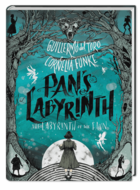
Cornelia Funke's prose in Pan's Labyrinth

Pan's Labyrinth by Guillermo del Toro  garnered critical praise when it came out in 2006. Capturing how the human spirit prevails in the face of tragedy, the film rises above most horror/fantasy films. 

A new novel for young adults written by Cornelia Funke captures and amplifies the dark magic of the original. Her prose explains many of the aspects of the film that defies explanation. Here's an example. We learn that the insect "fairy's" favorite game was change: "Change was in her nature. It was part of her magic and her favorite game."

This explains why the "fairy" readily changes form from insect to fairy to carnivore.

While the movie evokes images, Funke's prose also gives us each character's internal train of thought.
In the book and the film, Mercedes has beauty, courage and worldliness. In contrast, Ofelia's  mother is hobbled by insecurity.

Funke says of Ofelia's mother, Carmen: "She sat once more in the wheelchair, as if the Wolf (the Capitan) had stolen her feet. He had crippled her."

All of this is metaphorical; Carmen can walk; she just cannot stand up for herself. 

Carmen does not believe in magic or fairy tales, believing only delusions e.g. she believes she needs the villainous man, Vidal.

Funke states in another breathtaking passage that illuminate Carmen's thinking:

 "We all create our own fairy tales. The dress will make him love my daughter, that's the tale Carmen Cardoso told herself, although her heart knew Vidal only cared for the unborn child he had fathered."

For a deeper understanding of del Toro's Pan's Labyrinth, read Cornelia Funke's version.

Saturday, March 28, 2020

Leadership


Great leadership advice for managers.

https://www.accel-5.com/learn/video/take-care-of-your-teams-emotional-and-physical-health

Managers must think about the mental and physical health of workers. Healthy employees do more work, turn-over is less, and it is also inherently the right thing to do. 

Workers need to feel socially supported. 


Pfeffer, Jeffrey. Power: Why Some People Have It--And Others Don't.

Sutton, Robert I. and Jeffrey Pffeffer. The Knowing-Doing Gap. 
Photo by Josh Hild from Pexels

Wednesday, March 25, 2020

Learning at home videos

My county just issued a shelter-in-place. Though emergency personnel are working, many others will have to stay home. YouTube offers some free educational videos for families:


Amoeba Sisters,
I love the Amoeba sisters; they've even updated their virus video that explains in simple terms how viruses aren't technically living things. Even though they aren't living, lytic and lysogenic cycles allow them to multiply. For ages 13+

HHMI Biointeractive,
Numerous videos with easy-to-understand graphics.

Explains how in Photosynthesis, for instance,  water donates electrons and carbon accepts them, resulting in the formation of carbohydrates. Explains what happens inside the chloroplasts--the light reactions and Calvin cycle.  For High school readers and up.