In Wanderers an unknown pathogen wreaks havoc across the United States.
The virus makes a zoonotic jump from bats to humans resulting in a pandemic, civil unrest, and pandemonium.
While all this sounds familiar to what we’ve experienced with Covid-19, Wendig actually began devising the novel in 2016–four years before the Covid 19 outbreak.
In addition to the pathogen, characters also grapple with an AI that becomes sentient and autonomous, Black Swan.
Sadie explains how discomfiting the technology can be:
“Imagine that you create this thing, this quantum computer mind, and you begin to train it, and you realize it has a mind of its own. And then, on day, it tells you something: It has been speaking to itself in the future, and it believes that civilization will one day end.”
Though she believes she controls it, the AI begins to act independently. Predicting the pandemic, Black Swan takes control of a nanotech company and its swarm of nanotech bots. BlackSwan’s actions ensure that a portion of humanity will survive albeit at a great cost.
The lives of a disgraced scientist, an aging rock star, a teen-aged aspiring photographer, and a preacher intersect in this trenchant novel. As they become personally drawn into the crisis, each of them grapples with the politicization of the pandemic and the moral uncertainties of AI.
If you enjoy The Last of Us, you may enjoy this novel.
Chuck Wendig has also written Star Wars: Aftermath (2015), Invasive (2016), and The Book of Accidents (2021).
The Last of the Hunter-Naturalists: Ted and Kermit Roosevelt.
While it seems counterintuitive to us today, many hunters were also conservationists. Theodore Roosevelt and his sons, Ted and Kermit Roosevelt, were some of the last hunter-naturalists.
Hunter-naturalists believed the only way to study, and ultimately conserve a species, was to hunt and shoot specimens.
A rifle gifted to Theodore Roosevelt displayed in the National Museum of American History’s 2020 exhibit, “Elephants and Us”, exemplifies this paradox. The rifle was given to Roosevelt for “his services on behalf of preservation of species.”
Theodore Roosevelt is known for conserving 230 million acres of federal land — turning the lands into preserves, refuges, and national parks. He was also an avid hunter who passed that tradition on to his sons, Ted Jr., Kermit, Archibald, and Quentin.
Roosevelt Sr. was well-known for hunting big game — elk, bear, elephant, cougar, buffalo, yet he was also known for advocating “fair play.” He famously refused to shoot a bear in Mississippi because it was tied to a tree. Roosevelt Sr. considered it unsportsmanlike to shoot a bear that was unable to run or defend itself.
Ted and Kermit Roosevelt, who are eager to prove themselves after several personal and financial scandals, embark on a mission to find China’s mystical black and white bear. In order to study it, they will shoot, skin, and mount the animal in a museum.
Before the invention of tranquilizers, GPS tracking devices, and satellites, capturing and killing an animal was the only practical way to study a species. Naturalists like Charles Darwin and John James Johns routinely killed their animal subjects to study them.
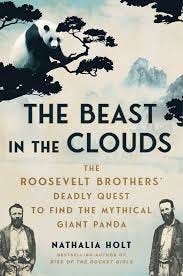
The Beast in the Clouds by Nathalia Holt (2025)
During the 1928 trip to Asia, the Roosevelt brothers and their party collect unusual sheep and deer specimens e.g. Marco Polo sheep, bharal, and serow. In fact, Nathalia Holt writes in her 2025 book on the exploration that the party collected 5,000 bird skins, 2,000 small mammals, and 40 large mammals.
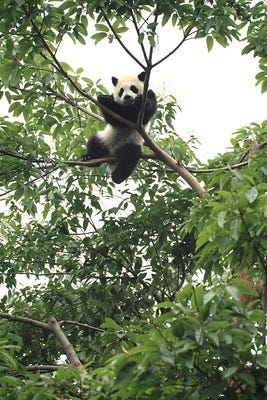
Surprisingly, until 1869, the Westerners had not even heard of a panda. The animal first became known to the West when Armand David, a missionary who was proselytizing in China, sent a Panda skin to Paris. David called the specimen a beautiful black and white bear.
The Chinese, however, considered the panda sacred. Though panda were elusive and rarely seen, early Chinese Emperors believed pandas were supernatural beings that could ward off evil spirits and natural disasters. Killing the panda or “beishung” was unthinkable to the Chinese.
In modern times, the Chinese call the Giant Panda or “daxiongmao” and it has become a cultural symbol. In the past, though, it was associated with many myths. Because the panda was elusive, it was mysterious and associated with mythological beings — Mo, a black-and-white bear that could eat metal or shitieshou, another iron-eating beast.
To help secure a panda, the Roosevelt recruit hunters from the Yolo region. These local hunters, however, were not only inexperienced, they also feared killing a “beishung.” They did not fear the bear’s aggression so much as they feared killing a sacred animal.
The brothers had already undergone too many trials to let that stop them. They had faced the drudgery through the “Valley of death,” close scrapes with bandits, life-threatening illnesses, and the constant danger of being caught up in China’s war between the Kuomintang and the Communists.
The panda specimen should have been the culmination of the expedition; yet, for the Roosevelt brothers, it was anticlimactic. Shortly after killing the bear, the brothers became downcast. As they prepare to ship the panda home to the Field Museum, news of the hunting party’s success creates a panda craze in the United States.
For the Roosevelt brothers, life would never be the same. For them, the great bear hunt and hunting, in general, is over. They would give speaking tours but would feel haunted by the expedition and its unintended consequences. Hunters want to use the brothers’ maps of the panda’s territory to bring home more panda carcasses or live cubs.
Before his death, Kermit works for a zoological society. He successful saves the Galapagos tortoise from extinction and calls for a complete ban on panda exports to the United States.
For more about Ted and Kermit Roosevelt’s life after the expedition, read Nathalia Holt’s The Beast in the Clouds.
A friend posted this to her FB page and I thought it was not only perfect for poetry month but for writing in general.
We are gatherers,
the ones who pick up sticks and stones and old wasp’s nests fallen by the door of the barn, walnuts with holes that look like eyes of owls, bits of shells not whole but lovely in their brokeness, we are the ones who bring home empty eggs of birds and place them on a small glass shelf to keep for what? How long? It matters not. What matters Is the gathering, the pockets filled with remnants of a day evaporated, the traces of certain memory, a lingering smell, a smile that came with the shell.
~ Nina Bagley
Click on Subscribe to posts below or "follow" above this post.