Reading Life

Followers

Monday, March 30, 2026

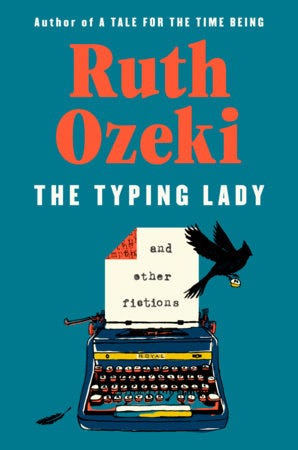
The Typing Lady by Ruth Ozeki


Not surprisingly, typewriters figure prominently in The Typing Lady: and other fictions.

In “The Typing Lady,” the lady collects typewriters. When she types, though, an uncanny thing happens.

The typewriters write stories of their own — emotional tales that she cannot control. The “typing lady” takes the typewriters apart, looking for the mechanism that accounts for the literary outpouring, but she cannot discover the source.

In “Leafblower” Mel uses a manual typewriter, a Remington Rand, to type poems, her real love, and a laptop to earn a paycheck as a technical writer. She also takes care of an elderly couple in exchange for a cheap room over their garage.

In one of the best stories, “Ships in the Night,” Cayenne, an aspiring romance writer, has a portable pink Olivetti. She wants to launch a career as a writer so her daughter can have a more stable life.

In “Feelings” two mean-spirited girls decide to engage in a school project. They are to write a report about an act of compassion they undertake in their community. Kai types a letter to a lonely classmate on a 1964 IBM Model C Executive.

Ozeki’s stories are filled with aspiring writers who try but fail to send deeply personal letters. In The Typing Lady characters write deeply personal missives that they can never send (“The Anthropologist’s Kid,” “Feelings,” and “One Art”).

More than that, though, Ozeki’s stories are filled with writers whose writing ambitions will never be satisfied. Cayenne, who wanders between lovers, keeps changing the plot of her novel. The daughter in “Ships in the Night,” knows her mother will never finish her romance novel.

The last two stories even more directly deal with how difficult it is to lead a creative life. The couple in “Where Ambition Goes to Die,” have a strained relationship because of the husband’s ambition to write fiction. In this story, his ambition becomes a black-haired girl filled with daring and impulsive ideas. The couple is calmer now that the black-haired girl is gone. After she disappears, they sleep “unhaunted.”

In “The Problem of the Body,” an author plans to fake her own death to avoid going on a book tour. She also appropriates her granddaughter’s dating app. She goes to cafes and chats with boys who think they are meeting her granddaughter. Though she knows its creepy, she does this until one of them recognizes her as “that writer.”

These stories are impressively complex and nuanced. Each story is in some way related to the art of writing, storytelling, and communicating in an increasingly confusing world. Much like Colm Toibin’s stories, they explore the drama of what is unsaid or the meeting that never happens.


Friday, March 20, 2026

Typewriters


I’ve always been drawn to typewriters. With typewriters, words hit the page with a noticeable “thunk.” Words cannot easily disappear the way they can with word processors. Typists have to backspace and type X’s or use corrective tape which gives writers pause and time to revise. Typed words have a permanence that cannot be found in today’s word processors, tablets, and phones.

My mother had a Remington Standard typewriter from the 1960s that she treasured. Even then in the 1970s and early 1980s it was a relic. The typewriter weighed a ton so moving it from the desk to the table required considerable effort.

The Remington had green, gray keys. The rubber carriage moved along with the words. When it was fully extended, writers heard a small ding telling them it was time to reposition that carriage. In a way, that simple act was electrifying for me as a kid. Pushing that slight metal bar and repositioning the carriage was like reloading a gun. Not that I had guns or knew anything about them.

The physical motion of moving the carriage was empowering because it meant I had accomplished something. I had expressed something exciting and tangible on paper.

I must confess I had an unrealistic view of writing and was often disappointed with my creative output. When I started a new story, I felt like the writer in the Carol Burnett and Harvey Korman skit who could create worlds as he clacked away. But just like the writer in that skit, I was rarely happy with the results.

I didn’t become the writer that I dreamed of becoming, yet I’m still drawn to typewriters. Many fantastic works of fiction depict typewriters prominently. 

One of these works is Suzanne Rindell’s The Other Typist. This novel features Rose who becomes obsessed with fellow typist, Odalie's world. Both are typists for the New York City Police department who type the criminals’ confessions in the 1920s. Told from Rose's unreliable perspective, this work is a fascinating psychological novel.

https://medium.com/@chantal.walvoord


Monday, March 16, 2026

100 Day Project--Day 2


 Designing a project is essential. 

Rich Armstrong who describes himself as a multi-hyphenate artist and career coach has written a book about designing the perfect 100 Day Project.  

 More tips for creating a successful 100 Day Project:

 https://craftindustryalliance.org/tips-and-tools-for-creating-a-successful-100-day-project/


Monday, March 9, 2026

The 100 Day Project


The 100 Day Project is perfect for designers, writers, and any other creative.

https://designobserver.com/five-years-of-100-days/

I'm frankly surprised that the 100 Day Project is not embraced more by public libraries. One library that does a 100 day project is the Daniel Boone Regional Library. Kudos to them. 

Suleika Jaouad explains how the 100 Day Project helped her during a particular low point in her life in The Book of Alchemy. 

https://medium.com/@chantal.walvoord