Reading Life

Followers

Saturday, June 1, 2019

The Tuscan Child by Rhys Bowen

Bowen's historical novel, The Tuscan Child, is a gratifying read. 

Joanna and her father, Sir Hugo, couldn't be more different. After his death, Joanna is startled to find a love letter to a woman in Italy. 

Intrigued, Joanna goes to San Salvatore in Italy, to discover more about her father's life. She knew he had crashed while serving in World War II but she had not known the exact location, San Salvatore, a hill town in Tuscany.

Though there are no hotels in San Salvatore, Joanna finds a comfortable place to stay. She feels at home with Paola's family until a strange event occurs. Someone has drowned one of the local men in the well near Joanna's rented room.

Police think Joanna, a foreigner, is suspicious, even though she insists she has nothing to do with the man's murder.

Renzo, the son of a rich landowner in San Salvatore, has a connection to her father and the woman he names in the letter, Sofia Bartoli. Is he the "beautiful boy" her father mentions in the same letter?

The novel takes many twists and turns and Joanna learns what's true and what's false. 

At the Corpus Christi festival she beings to see Renzo in a new light.  Though she does not trust Renzo, something is drawing her and him together.


This is a charming World War II story with light intrigue and light romance.

Tuesday, May 28, 2019

Still I Rise

Here's hope for a gray day.


Still I Rise


By Maya Angelou

You may write me down in history
With your bitter, twisted lies,
You may trod me in the very dirt
But still, like dust, I'll rise.

Does my sassiness upset you?
Why are you beset with gloom?
’Cause I walk like I've got oil wells
Pumping in my living room.

Just like moons and like suns,
With the certainty of tides,
Just like hopes springing high,
Still I'll rise.

Did you want to see me broken?
Bowed head and lowered eyes?
Shoulders falling down like teardrops,
Weakened by my soulful cries?

Does my haughtiness offend you?
Don't you take it awful hard
’Cause I laugh like I've got gold mines
Diggin’ in my own backyard.

You may shoot me with your words,
You may cut me with your eyes,
You may kill me with your hatefulness,
But still, like air, I’ll rise.

Does my sexiness upset you?
Does it come as a surprise
That I dance like I've got diamonds
At the meeting of my thighs?

Out of the huts of history’s shame
I rise
Up from a past that’s rooted in pain
I rise
I'm a black ocean, leaping and wide,
Welling and swelling I bear in the tide.

Leaving behind nights of terror and fear
I rise
Into a daybreak that’s wondrously clear
I rise
Bringing the gifts that my ancestors gave,
I am the dream and the hope of the slave.
I rise
I rise
I rise.


source:  https://www.poetryfoundation.org/poems/46446/still-i-rise

Friday, May 24, 2019

Ultra Processed Foods

An article from the NIH directors blog reports the finding that ultra processed foods lead to weight gain.

https://directorsblog.nih.gov/2019/05/21/ultra-processed-diet-leads-to-extra-calories-weight-gain/

Several online commenters wondered why a list of ultra processed food was not included. As it turns out, Cooking Light, has a February 2019 article on that topic.

https://www.cookinglight.com/eating-smart/nutrition-101/what-is-ultra-processed-food


Monday, May 6, 2019

My Name is Lucy Barton by Elizabeth Strout

Set in New York, My Name is Lucy Barton, is a psychological portrait of a woman who has survived a terrible upbringing of cruelty and poverty. 


At the start of the novel, Lucy, who is temporarily hospitalized, received visits from her mother. Lucy is grateful for the visits and grateful for the doctor who seems to genuinely care for her. 

Underneath the mother's kindness, however, there is an undercurrent of cruelty. Lucy is the only one who has successful escaped her humble beginnings in Amgash, IL. 

Lucy has gone to college and become a writer but she still experiences loneliness and disconnection. Once after Lucy has her first baby, she calls her mother. Her mother, however, refuses to accept the charges for the collect phone call.

This novel is set in the 1980s before cell phones and smart phones. Another crucial part of the novel is the AIDS epidemic; Lucy feels a connection with outcasts and with the neighbor who is dying. 

The brothers and sisters she left behind in Amgash feel some resentment for Lucy, who made it out of the rural community. Those themes are explored in Strout's award-winning short story collection,  Anything is Possible

Lucy discovers she will always be connected to  her family even though she has left them and started life anew elsewhere. 

The Chrysler building on the cover makes sense.

Tuesday, February 5, 2019

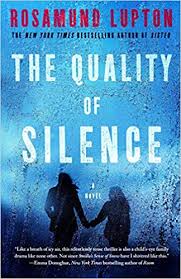
The Quality of Silence by Rosamund Lupton


This is a novel that pulls readers in immediately because there’s so much at stake for Yasmin and her daughter, Ruby. The pair hope to rescue Matt, Yasmin’s husband and Ruby’s father, from an outpost in Northern Alaska that burned to the ground. 

Despite a terrible childhood, Yasmin has found the love of her life in Matt whose adventurous spirit matches her own. Even with a few challenges–like her daughter’s disability and Matt’s tendency to wander, Yasmin believes in his love. 

Police, however, have decided there are no survivors. Refusing to give up hope, Yasmin and Ruby make their way North by convincing a truck driver to take them to DeadHorse. From there they hope to take a taxi plane to Anaktue. 

Yasmin takes matters into her own hands when he becomes ill; she drives the truck herself across dangerous icy roads.Fans of psychological suspense will love Lupton’s foray into the world of ice trucking. This is a complex novel about motherhood, disability, and ethical choices. 

On one hand, Yasmin has felt that becoming a mother (especially a mother to a child who is so vulnerable) has made her invisible:

“It shocked her to realize that for years she’d felt bland, dull even to herself. Around her, everyone else’s characters were clearly defined, the borders of their personalities etched sharply, but not hers. She’d had tasks and chores and love for Ruby, huge love for her, but how would she have described who she was? Somewhere along the line she’d lost the idea of herself.”

Thus, the mother’s dangerous quest to find her husband is also quest to find her lost self. Yasmin endures the bitter cold of the Dalton highway, a possible stalker and the hazards of trucking during a storm.

Equally brave, Ruby decides how and when she’ll use her voice. Despite her mother’s repeated requests that she use her real voice, Ruby uses “Voice Magic” and twitter. In one courageous move at the end, Ruby uses this technology to thwart the evil doers who wish to harm her family.

Sunday, December 30, 2018

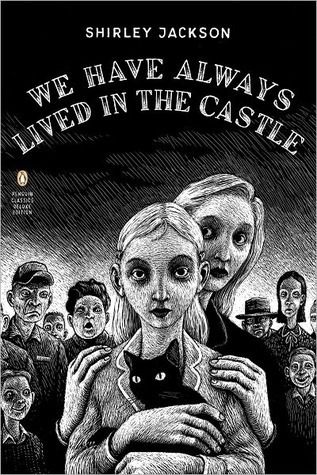
We Have Always Lived in the Castle


We Have Always Lived in the Castle by Shirley Jackson


Most readers know Shirley Jackson’s chilling short story, “The Lottery,” or her gothic novel, The Haunting of Hill House. Her masterpiece, We Have Always Lived in the Castle, is not as well known. 

We Have Always Lived in the Castle is a murder-mystery that combines Gothic elements with psychological suspense. 

Though it gives the routine of two seemingly ordinary women, it also peers into the mind of a deranged young girl:

“I have often thought that with any luck at all, I could have been born a werewolf because the two middle fingers on both my hands are the same length, but I have had to be content with what I had…I like my sister Constance, and Richard Plantagenet, and Amanita phalloides, the death-cup mushroom. Everyone else in our family is dead.”

Merricat, eighteen, lives in the past along with her sister, who is about 28, and her ailing Uncle Julian. For some reason, Merricat excludes him as a member of her family in the opening paragraphs of the novel.

Merricat, who believes in magic and protection spells, lives wholly in her own imagination. She believes her cat, Jonas, can tell stories. She thinks that burying objects and nailing items to a tree can protect her and her sister from the villagers. She often professes that she wants to go to the moon on a winged horse.

None of Merricat’s talismans have any effect though when a relative, Charles Blackwood, visits and takes over the family’s home. The visitor alters the family in irreversible ways. Much like the events that occurred six years ago, the visitor’s actions alters the fabric of their lives. 

Merricat insists that Charles is a “ghost” and a “demon.” He is, in fact, a greedy relative who wants access to the family’s safe. Merrricat’s fanciful imagination however will not allow such a prosaic explanation. 

After the fire, and after the villagers exact terrible retribution, the Blackwood girls are more isolated than ever. 

Merricat and Constance insist, however, that they are happy even if they are deprived of their beautiful things–the italian staircase and drawing room. Without their their fancy plates and drapes, they are in a barren, yet isolated place. They are finally “on the moon.”

Friday, December 28, 2018

A Sense of Belonging in The Haunting of Hill House by Shirley Jackson

The Netflix series of the same title, though different, has spawned new interest in this classic about a haunted house. Dr. Montague invited participants to the house that he believes are susceptible to the paranormal. Only later does he realize the enormity of his misjudgment. One of the participants, who is more fragile than the others, is driven to insanity. What Eleanor wants more than anything is to be accepted. She has taken care of her ailing mother at the expense of her own happiness. Now, in her thirties, in want of adventure, Eleanor "borrows" her sisters car and meets the group at Hill House. Poignantly, Eleanor thinks that she has made lasting friendships in less than a week. Naively, she assumes Theo would want to continue their friendship after the Hill House adventure is over. Eleanor says she intends to move into Theo's small apartment after she leaves Hill House. This is surprising at first given how much they argue. They fight over foolish things e.g. Luke's attention or being in the group's "spotlight." More than anything else, The Haunting of Hill House is about yearning for a sense of belonging. "Come Home, Eleanor," a ghostly hand writes on a wall in blood. Eleanor is mortified that the ghost has called her out by name. This isn't the spotlight that she wants. Eleanor, who acutely yearns to belong, is afraid of appearing foolish and being rejected. When Luke says she isn't welcome anymore, after her unusual behavior on the staircase, Eleanor is beyond crushed. The tragic ending coincides with her lamentations at being rejected from Hill House.