Reading Life

Followers

Thursday, April 2, 2020

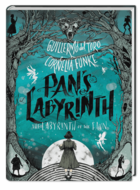
Cornelia Funke's prose in Pan's Labyrinth

Pan's Labyrinth by Guillermo del Toro  garnered critical praise when it came out in 2006. Capturing how the human spirit prevails in the face of tragedy, the film rises above most horror/fantasy films. 

A new novel for young adults written by Cornelia Funke captures and amplifies the dark magic of the original. Her prose explains many of the aspects of the film that defies explanation. Here's an example. We learn that the insect "fairy's" favorite game was change: "Change was in her nature. It was part of her magic and her favorite game."

This explains why the "fairy" readily changes form from insect to fairy to carnivore.

While the movie evokes images, Funke's prose also gives us each character's internal train of thought.
In the book and the film, Mercedes has beauty, courage and worldliness. In contrast, Ofelia's  mother is hobbled by insecurity.

Funke says of Ofelia's mother, Carmen: "She sat once more in the wheelchair, as if the Wolf (the Capitan) had stolen her feet. He had crippled her."

All of this is metaphorical; Carmen can walk; she just cannot stand up for herself. 

Carmen does not believe in magic or fairy tales, believing only delusions e.g. she believes she needs the villainous man, Vidal.

Funke states in another breathtaking passage that illuminate Carmen's thinking:

 "We all create our own fairy tales. The dress will make him love my daughter, that's the tale Carmen Cardoso told herself, although her heart knew Vidal only cared for the unborn child he had fathered."

For a deeper understanding of del Toro's Pan's Labyrinth, read Cornelia Funke's version.

Saturday, March 28, 2020

Leadership


Great leadership advice for managers.

https://www.accel-5.com/learn/video/take-care-of-your-teams-emotional-and-physical-health

Managers must think about the mental and physical health of workers. Healthy employees do more work, turn-over is less, and it is also inherently the right thing to do. 

Workers need to feel socially supported. 


Pfeffer, Jeffrey. Power: Why Some People Have It--And Others Don't.

Sutton, Robert I. and Jeffrey Pffeffer. The Knowing-Doing Gap. 
Photo by Josh Hild from Pexels

Wednesday, March 25, 2020

Learning at home videos

My county just issued a shelter-in-place. Though emergency personnel are working, many others will have to stay home. YouTube offers some free educational videos for families:


Amoeba Sisters,
I love the Amoeba sisters; they've even updated their virus video that explains in simple terms how viruses aren't technically living things. Even though they aren't living, lytic and lysogenic cycles allow them to multiply. For ages 13+

HHMI Biointeractive,
Numerous videos with easy-to-understand graphics.

Explains how in Photosynthesis, for instance,  water donates electrons and carbon accepts them, resulting in the formation of carbohydrates. Explains what happens inside the chloroplasts--the light reactions and Calvin cycle.  For High school readers and up.

Friday, March 20, 2020

Write it Down

Professor urges students to write everything down in this unprecedented time. During a pandemic, 'write it down,' University of Virginia professor Herbert 'Tico' Braun urges students.

Actually, this is good advice for all writers. Writing your experiences will keep a record of this time in history; it can also be therapeutic.

photo courtesy of Pexelscom, Tirachard Kumtanom
https://news.virginia.edu/content/write-it-down-historian-suggests-keeping-record-life-during-pandemic?utm_source=DailyReport&utm_medium=email&utm_campaign=news&fbclid=IwAR09KejyTLZrFNxZ-Up65CjFp6ix84CPXP9wfCQ5c-a1RwTlkZaWJIbI5hI

Tuesday, March 17, 2020

1917

I watched this film last weekend with a few others. The cinema had limited seating due to the covid 19 outbreak. This was before CDC recommended even greater limitations on gatherings.

1917 is a somber film that depicts a perilous time. Just a year later, in 1918, a pandemic would cause panic and confusion, much like is happening now in 2020.

What struck me at the end was the battalion's lack of gratitude. But then again, if you can't see the whole picture--the aerial maps--than its hard to be grateful.

Friday, March 13, 2020

Into the Water by Paula Hawkins

What looks like an accidental drowning might actually be a suicide. Told in alternating voices, this suspense-saturated drama is Hawkins' second novel. 

If you missed it the first time around, like I did, your library probably has plenty of copies.

Nel isn't very well liked in her small community. Even her sister bears a grudge against her. The community resents that she's writing a book about the witchcraft trials and other historical events that took place in Beckford. 


Nel chooses to write not only about the historical deaths by drowning but also the more recent drownings. This infuriates Louise, the mother of a girl who recently committed suicide in the pool. 

Soon afterward Katie's death, Nel also drowns in the drowning pool. Some family members think she has killed herself but others suspect something more sinister.

Among the suspects, there is a jealous sister, a handsome male teacher, a dangerous ex-boyfriend, an outraged mother, and a cantankerous cop.

Nel's teenaged daughter is also in danger, leaving readers to wonder if she will suffer the same fate as her mother and all the other "troublesome" women. 

Though some have said they enjoyed this book less, its actually more enjoyable than The Girl on the Train. Into the Water is multi-faceted and surprising, thought-provoking and riveting. 


Tuesday, February 18, 2020

The Doll Factory by Elizabeth MacNeal

In this novel, a pair of twins unhappily work in a doll shop and  a collector of rare specimens, Silas, takes interest in one of them. Iris also fall under the gaze of a member of the Pre-Raphaelite Brotherhood, a group of painters hoping to take Victorian London by storm.

The drudgery of Iris' work is palpable. What she wants more than anything is to become an artist. Louis, a member of the Brotherhood, offers her a chance of a lifetime. He tells Iris,

"I can teach you how to use oils, and perhaps next year you can enter a canvas into the Royal Academy Summer Exhibition."

The offer, however, is contingent upon her becoming a model for him. He promises to also teach her to paint--something that Iris has longed for all her life. 

Her family disowns her after she becomes Louis' model. They feel its unbecoming of a woman to live alone and work as an artists model. This leaves her more vulnerable to the local psychopath, Silas. 

MacNeal skillfully creates this character by first hiding his flaws. Silas originally appears as just another impassioned artist, except in his case he is interested in curiosities. He preserves dead animals and skeletons, butterflies, and other odd assortments.

Oddly enough, several women associated with Silas go missing--Flick, Bluebell, and now Iris. 

The novel skillfully draws readers into the Victorian world. Readers care about the plight of the protagonists--Louis who has gotten himself in a quandary--and Iris who desperately wants to be free to paint. Like the queen in Louis' painting, Iris finds herself figuratively and literally imprisoned. 

In writing that rivals the best suspense novel, MacNeal takes readers into the mind of a serial killer and contrasts it with a desperate woman's fight for freedom.